1.The Essence of Bitcoin Mining
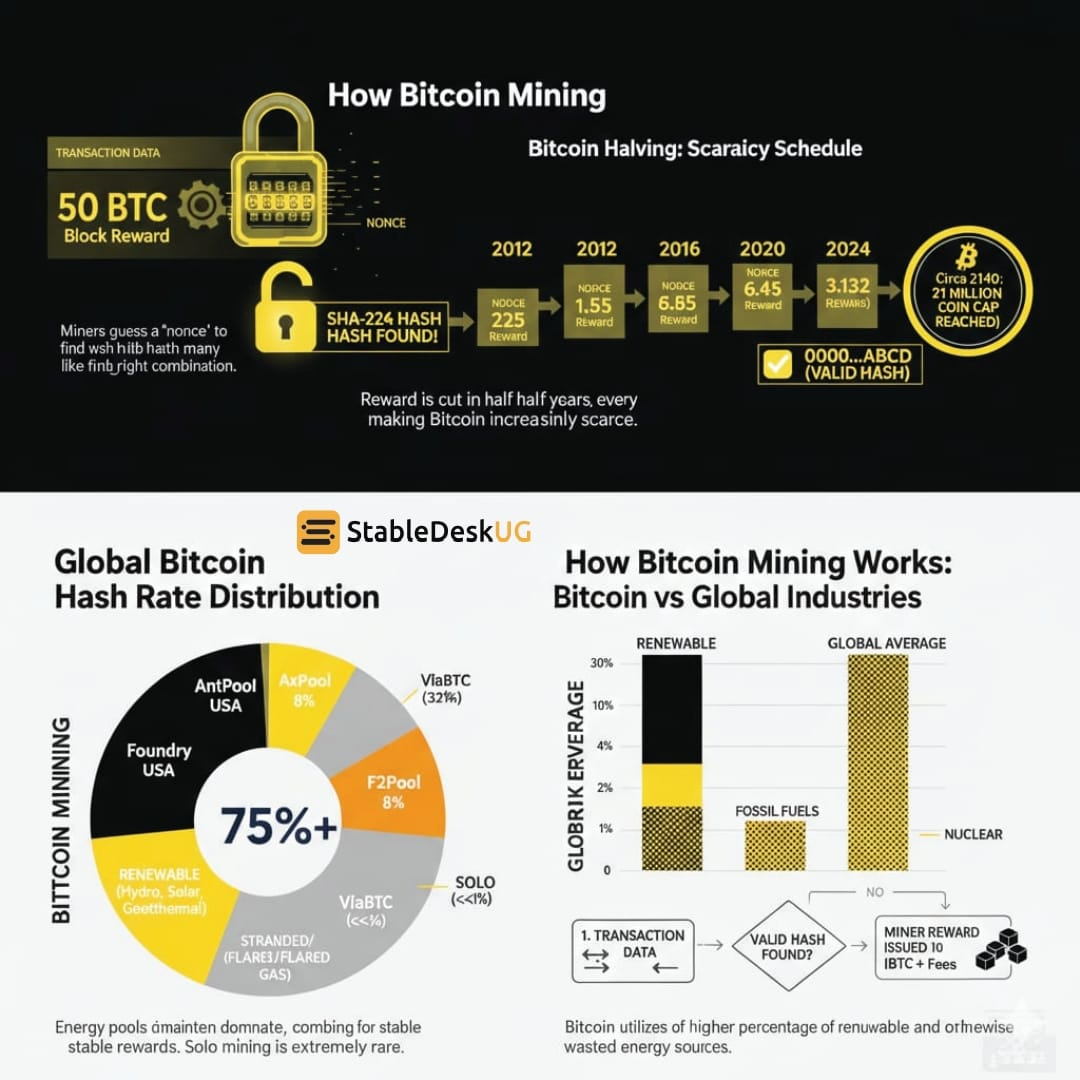
Bitcoin mining is not a physical activity but a competitive computational process used to secure the network and create new currency (tokens). It functions as a decentralized authority that validates transactions without the need for a central bank. Miners compete in a “computational arms race” to solve mathematical puzzles; the winner earns the right to add a new block of transactions to the blockchain.
2. The Technical Process: Solving Puzzles
Miners perform specific technical tasks to secure the network:
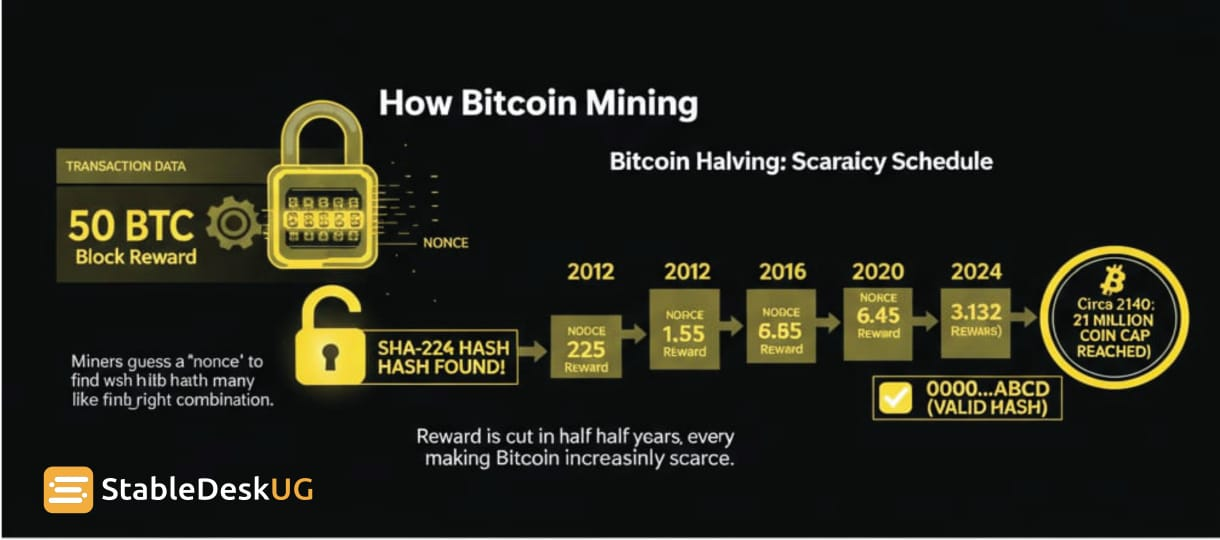
Hashing: Miners take pending transactions, add a random number called a nonce, and run them through the SHA-256 cryptographic hash function.
The Goal: To find a hash with a specific number of leading zeros. This is compared to a “lock with trillions of combinations” that can only be solved through trial and error.
Difficulty Adjustment: The network automatically adjusts the difficulty of these puzzles every 2,016 blocks (roughly every two weeks) to ensure a new block is found every 10 minutes on average, regardless of how much computing power is active.
3. Mining Rewards and Economics
Miners are incentivized through two primary revenue streams:
Block Rewards: Newly created Bitcoins are awarded to the successful miner.
The Halving: To control inflation, these rewards halve approximately every four years. The reward started at 50 BTC in 2009 and most recently dropped to 3.125 BTC in 2024. This will continue until the 21-million-coin cap is reached around the year 2140.
Transaction Fees: Miners also collect optional fees attached to each transaction within a block, which will eventually become their sole source of income once all Bitcoins are mined.
4. Profitability and Energy Consumption
Mining is an industrial-scale operation where profitability depends on several fluctuating factors: Bitcoin price, mining difficulty, electricity costs, and hardware efficiency.
The Environmental Debate: The network consumes 100–150 terawatt-hours of electricity annually, comparable to the usage of countries like Argentina.
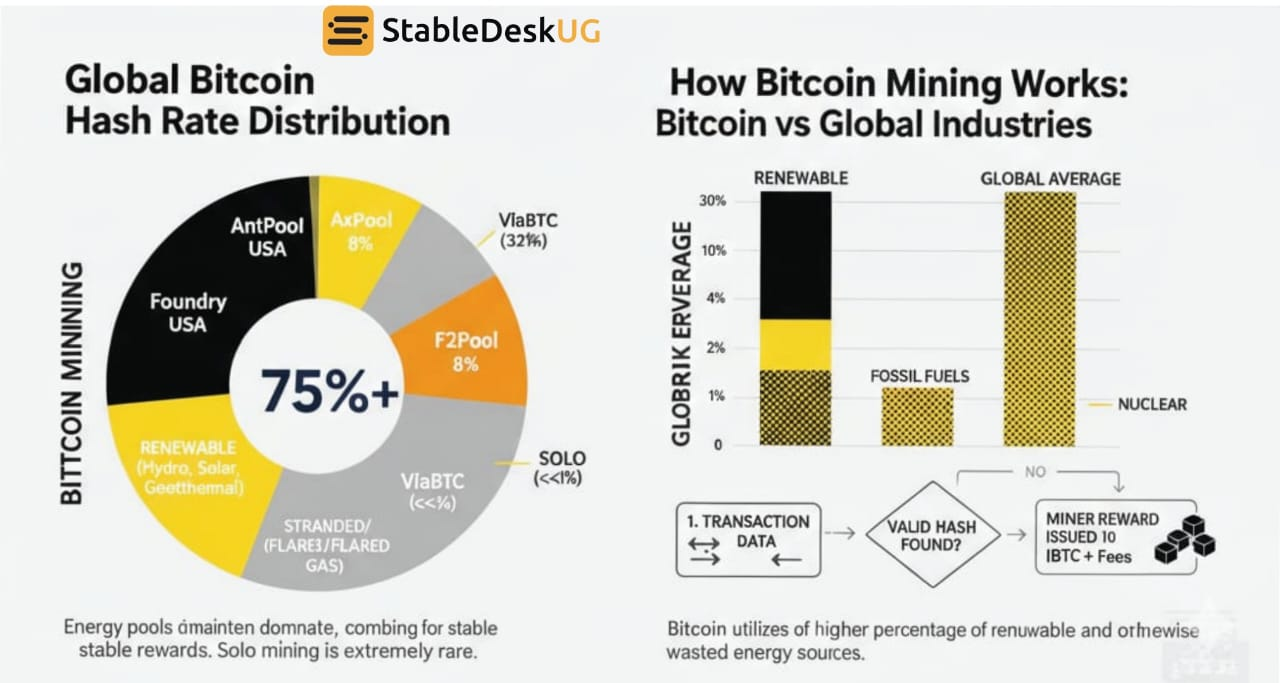
The Renewable Argument: Advocates argue that miners act as a “buyer of last resort,” utilizing stranded or wasted energy (like hydroelectric or flared natural gas). Estimates suggest 40% to 75% of mining is powered by renewable sources.
5. Mining Pools vs. Solo Mining
The text distinguishes between two ways individuals and companies participate:
Solo Mining: A miner competes alone. While they keep 100% of the reward, the odds of success are so low that a miner might go years or decades without earning anything.
Mining Pools: Miners combine their computational power (hash rate) to find blocks more frequently. The rewards are split proportionally among participants, providing a steady, predictable income (e.g., earning 0.0001 BTC regularly instead of 3.125 BTC once every several years).