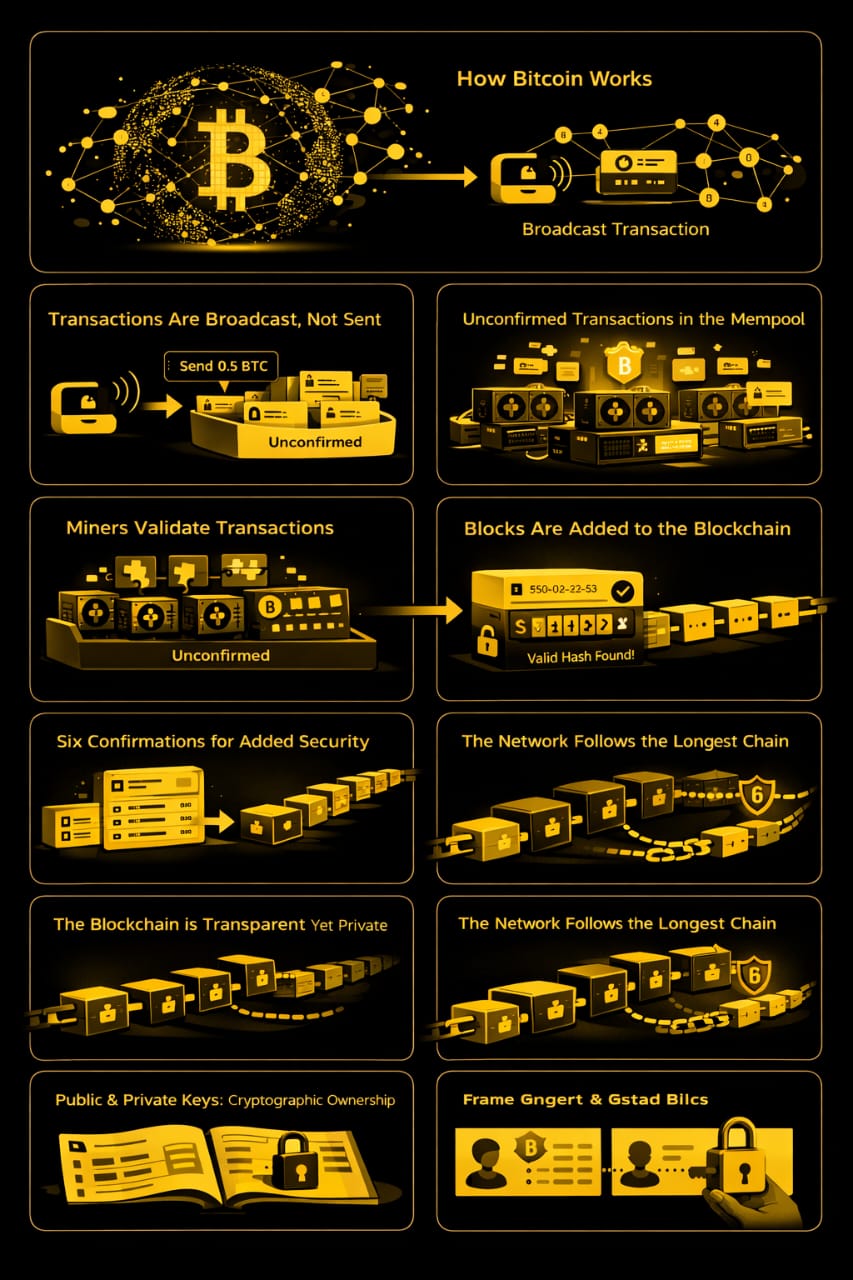
Introduction: Digital Money and Decentralization
Acknowledging Bitcoin’s reputation for volatility and its rise as a potential tool for wealth building. It highlights the core difference between Bitcoin and traditional (fiat) currencies: decentralization. While most people use Bitcoin without understanding the underlying technology, the article argues that grasping its mechanics is essential to understanding why it is revolutionary and how it functions without a central authority.
2. Transaction Verification and the Role of Miners
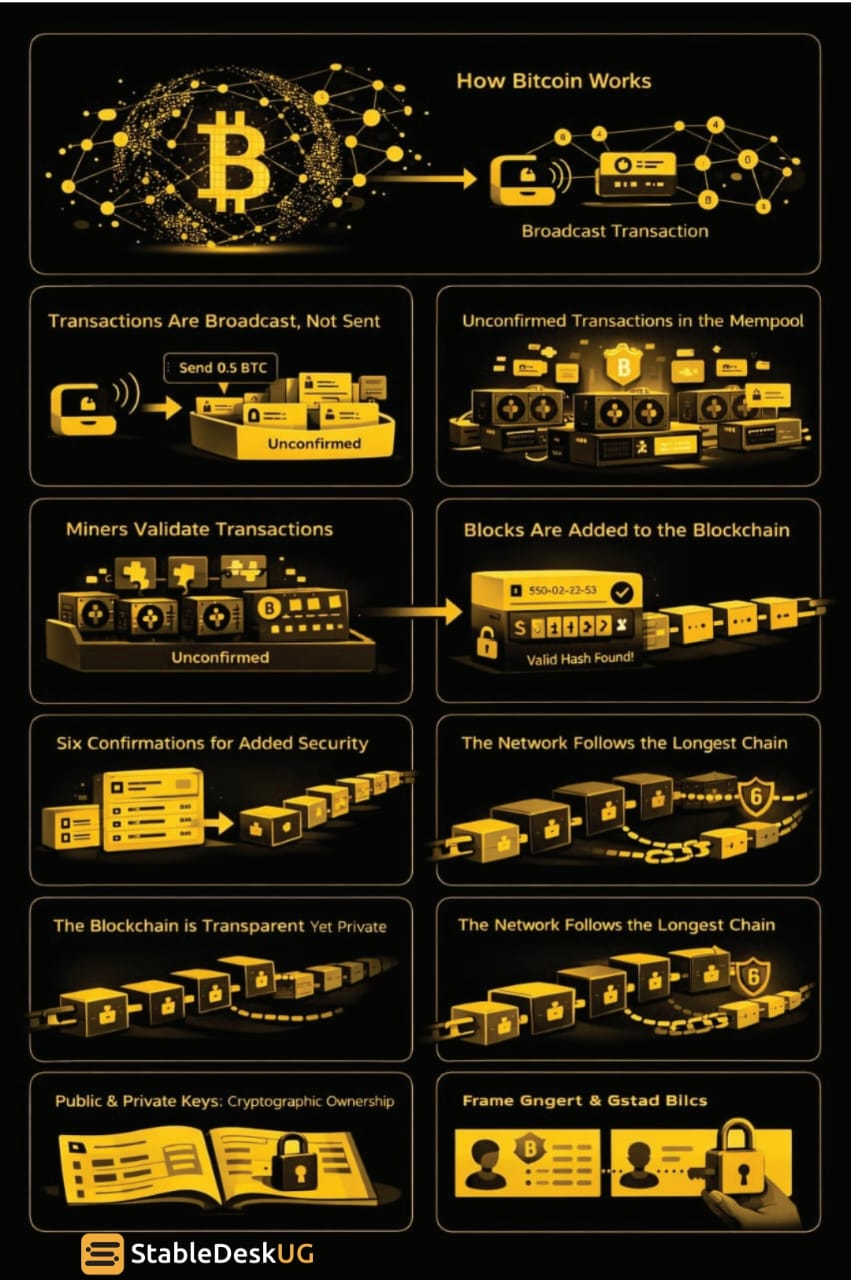
Bitcoin transactions are not transfers of physical files but rather broadcasted messages to the network. Miners play the critical role of verifying these messages.
Proof of Work: Miners use powerful computers to compete in solving complex mathematical puzzles.
Verification Process:
Step 1-2: Transactions are broadcast to the network, where “nodes” verify the digital signature and ensure the sender has sufficient funds. Valid transactions wait in a mempool.
Step 3-4: Miners select transactions (prioritizing those with higher fees) and try to find a nonce—a number that, when hashed with the block’s data, produces a specific result with leading zeros.
Step 5-6: The first miner to solve the puzzle broadcasts it; if other nodes confirm it is correct, the block is added to the blockchain, and the transaction is finalized.
3. Why Mining Matters
Mining provides the network with four essential pillars:
Security: The massive computational power required makes it nearly impossible for an attacker to alter past transactions.
Decentralization: Anyone can become a miner, preventing any single entity from controlling the ledger.
Issuance: It is the only way new bitcoins are created, following a predictable and transparent schedule.
Incentives: Miners are rewarded with bitcoin and fees, aligning their self-interest with the network’s security.
4. The Blockchain: A Permanent Ledger
The blockchain is described as an authoritative, global spreadsheet replicated across thousands of computers.
Immutability: Each block contains a hash of the previous block, creating an unbreakable chain. Altering one block would require recalculating every subsequent block, which is computationally unfeasible.
Six Confirmations: To ensure a transaction is irreversible, users typically wait for six blocks to be mined on top of theirs (roughly one hour).
The Longest Chain Rule: If two miners solve a block simultaneously, the network follows the chain with the most cumulative proof of work to reach a consensus.
5. Cryptographic Ownership: Public and Private Keys
Ownership of Bitcoin is defined by Asymmetric Cryptography.
Private Key: A secret 256-bit number that proves ownership and allows the spending of coins. It must never be shared.
Public Key: Derived from the private key, this acts as an address that can be shared publicly to receive funds.
Custody: The text stresses the mantra “not your keys, not your coins.” If you keep bitcoin on an exchange, you do not truly own it because you do not control the private keys.
6. Seed Phrases and Backups
To make private keys manageable, modern wallets use seed phrases (12 or 24 common words). This phrase can regenerate your keys if you lose your device. The document concludes with a strong warning: Write your seed phrase on paper and store it securely. Digital storage is vulnerable to hacking, and in the world of Bitcoin, there is no “password reset” or customer service to help if the keys are lost.